Building Smart Apps: How an App Development Company Integrates AI into Internal Workflows


App development company integrating AI into internal workflows in Orange County
14 min read
This article explains how app development companies leverage AI integration across the full software development lifecycle — from automated code reviews and machine learning testing to generative prototyping and custom AI models. Using OC Imagine's Irvine, California studio as a real-world example, the post outlines practical AI tools like Firebase, Flutter, and NLP platforms, and demonstrates how small and medium-sized businesses can achieve faster delivery, better customer experiences, and stronger ROI through smart app development.
Every app development company faces the same pressure. Build better products, ship faster, and keep your team from burning out. Today, AI integration makes all three goals possible at once. AI is changing how development studios work — inside and out. It helps teams automate coding tasks and add machine learning to mobile app features.
At OC Imagine, we see this every day in our Irvine, California studio. We work with small and medium-sized businesses across Orange County. We design, build, and launch smart apps that do more. In this post, we break down how app development companies use AI in their workflows — and why it matters for your business.
What AI Integration in App Development Actually Means
AI integration in app development means adding artificial intelligence tools into the way a team builds software. It does not only cover adding a chatbot to a finished product. It spans the full lifecycle — from planning and design to coding, testing, and launch.
A traditional software development process relies on manual effort at every stage. Developers write code line by line. Project managers track progress on spreadsheets. Each step takes time and adds the risk of human error.
AI integration changes that model at its core. For example, AI-powered code generation tools write repetitive code on their own. Machine learning models can spot where bugs will appear before testers start. Also, smart project tools flag delays before they happen.
The result is a faster and more reliable software development process from day one. AI integration is not a one-size-fits-all fix. The best app development companies shape their AI approach to each project.
Some teams use Firebase Studio for real-time data sync and cloud-based backend features. Others build cross-platform apps using Flutter with built-in AI models. The tools vary, but the goal stays the same: use AI to make every part of the workflow smarter.
According to recent research, development teams that adopt AI integration report up to 40% faster project delivery. They also see fewer bugs after launch. Those numbers matter — especially for small businesses in Orange County that need strong results without large budgets.
How App Development Companies Use AI to Automate Workflows
Workflow automation is one of the most powerful uses of AI in app development. When a development company automates its own processes, every client project benefits. Here is how leading app development companies put AI to work behind the scenes.
First, AI tools automate code reviews. Senior developers no longer spend hours checking code by hand. AI review tools scan code in seconds, flag issues, suggest fixes, and enforce standards on their own. This frees senior engineers to focus on bigger problems.
Second, automated testing powered by machine learning speeds up quality checks. Traditional QA requires testers to run hundreds of test scripts by hand. AI testing tools learn from past test runs and find the highest-risk areas of the codebase. As a result, teams catch and fix bugs early — before they reach the app store.
Third, AI-driven project tools change how teams plan their work. These tools look at past project data and predict how long tasks will take. They also surface risks early, so project managers can act before problems grow.
Fourth, AI chatbots handle routine tasks. Many development companies use chatbots to manage client update requests and answer common questions about project status. This cuts down long email chains and keeps developers focused on building.
Fifth, AI data integration connects all the tools a development team uses. This includes version control systems like GitHub, CRM platforms, and cloud tools. Instead of switching between many dashboards, developers get one smart view of every project. That kind of AI integration in business operations saves hours every week.
- AI-powered code generation writes repetitive code on its own, cutting development time
- Machine learning testing catches bugs faster than manual QA ever could
- AI-driven project tools rank tasks and flag delays before they slow teams down
- Smart analytics dashboards give developers real-time feedback on app performance
- AI chatbots handle routine client updates, freeing developers to build
- AI data integration connects CRM, ERP, and cloud platforms into one workflow
- Generative AI tools help teams build app prototypes in hours instead of weeks
In addition, generative AI tools are changing the early stages of app development. Teams use them to create wireframes, write user stories, and build prototypes in hours. This lets clients see a working model of their idea much sooner. It also reduces costly changes late in the process.

AI integration in app development workflow automation for app development companies
Key AI Tools Behind Smart Apps
Knowing which tools power AI integration helps businesses pick the right app development partner. Here are the key technologies that modern development companies rely on.
Firebase and Firebase Studio are essential for apps that need real-time data sync and cloud-based AI processing. Firebase connects directly with Google’s machine learning APIs. This makes it easy to add features like image recognition, natural language processing, and predictive analytics to a mobile app. Firebase Studio also helps developers build and test AI-powered apps faster.
Flutter is a popular cross-platform framework. It lets developers build apps for iOS and Android from one codebase. Flutter works well with AI and machine learning packages. For small businesses that need a polished app on both platforms, Flutter with AI integration is a strong choice.
Custom AI models go beyond off-the-shelf tools. Leading app development companies build and train models for each client’s specific needs. For example, a home services company in Orange County might need a model that flags which customers need a follow-up call. A luxury brand might need a model that suggests products based on browsing behavior. These custom AI solutions create real advantages that generic tools cannot match.
Natural language processing (NLP) powers apps that understand and respond to human language. NLP is a branch of artificial intelligence that helps computers read and process text. NLP-powered chatbots handle customer service questions, qualify leads, and onboard new users — all without human help. Chatbot development in Orange County has grown fast because NLP tools are now more accurate and affordable than ever.
Furthermore, AI analytics platforms give teams deep insight into how an app performs. These platforms track user behavior, find drop-off points, and suggest design fixes in real time. Teams get instant insights that help improve the app after launch.
Finally, API-based AI integration lets development teams add strong AI features without building everything from scratch. Services like OpenAI, Google Cloud AI, and AWS AI connect to an app’s backend via API. This approach keeps costs low while still delivering smart AI features — which matters a lot for small businesses with set budgets.
The Real Benefits of AI Integration for Small Businesses
Many small business owners think AI integration is only for large companies with large tech teams. However, the benefits for smaller businesses are often even greater.
First, AI integration cuts the time it takes to get a product to market. When a development company uses AI tools, the full process moves faster. For a small business owner, this means less waiting and more time earning from a live product. In markets like Orange County, speed to market can make or break your lead over competitors.
Second, AI-powered apps create better customer experiences. A small e-commerce business that adds an AI chatbot no longer needs extra support staff. The chatbot answers common questions at any hour. Also, it learns from each conversation and gets more helpful over time.
Third, AI integration helps small teams work at a much higher level. Workflow automation handles repetitive tasks — scheduling, reporting, and data entry. As a result, team members can focus on work that actually grows the business.
Fourth, custom AI solutions give small businesses access to data insights once reserved for large companies. For example, an Orange County home services company can use predictive analytics to forecast demand by area and season. A nonprofit can use AI to find which donor groups are most likely to respond to a specific campaign. These insights drive smarter decisions at every level.
Fifth, AI in human workflows cuts costly mistakes. AI systems catch billing errors, missed follow-ups, and inventory issues before they become expensive problems. Small businesses feel the impact of these errors more than large ones, so early detection is especially valuable. Also, businesses that invest in AI-powered app development often see strong returns fast. Research from McKinsey and Deloitte shows that companies using AI tools — even at the small business level — grow faster and score higher on customer satisfaction.
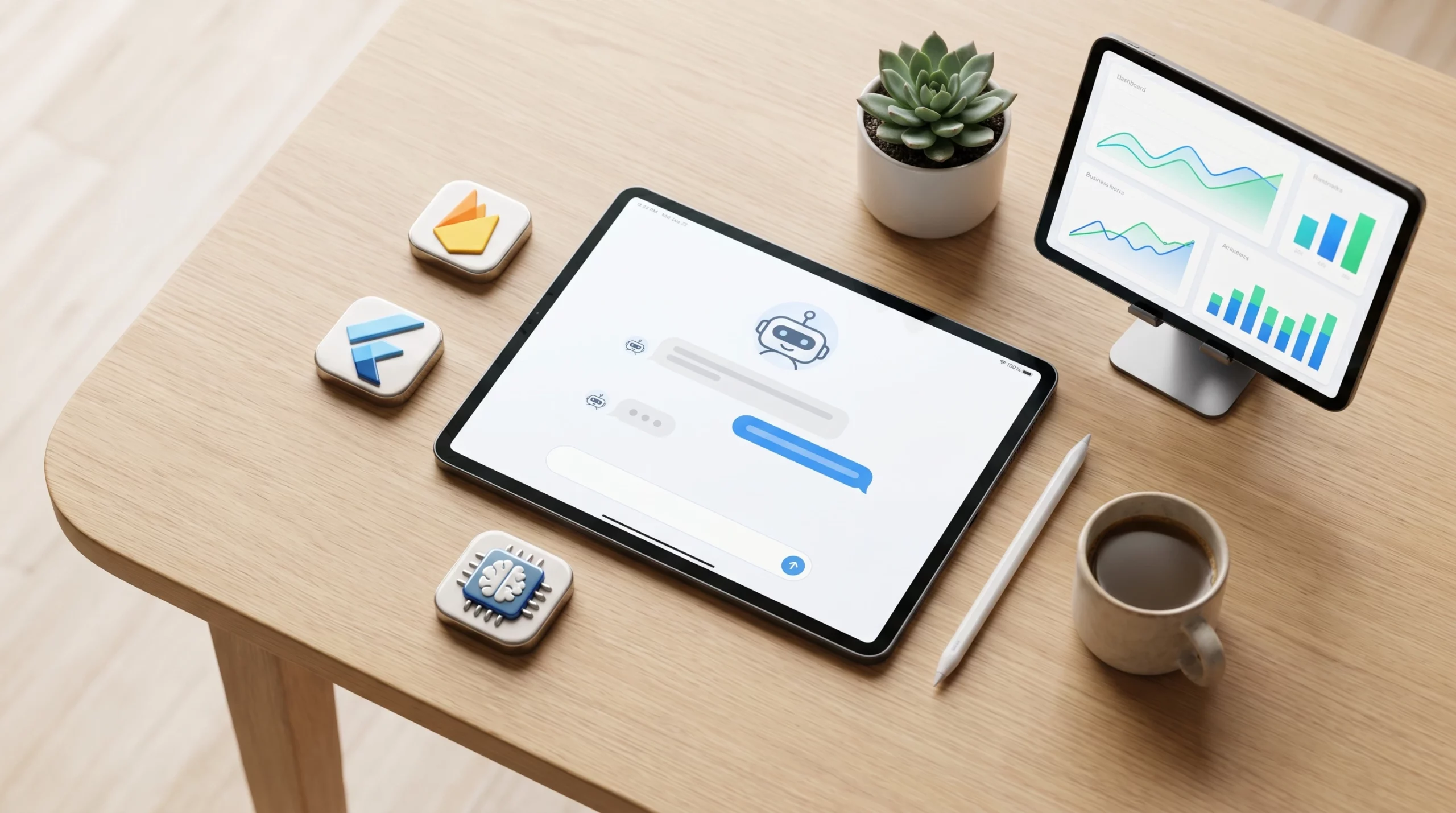
AI tools and technologies for mobile app development including Firebase and Flutter
Common Challenges and How to Overcome Them
AI integration is powerful, but it comes with real challenges. Knowing these issues early helps businesses plan better and avoid common mistakes.
Data quality is the first hurdle. AI models are only as good as the data they learn from. If your data is incomplete or outdated, the model will produce weak results. So before any AI work begins, OC Imagine runs a data readiness check. We help clients clean and organize their data so AI tools can use it well from day one.
Integration complexity is another issue. Many small businesses already use a mix of software tools. Connecting all of them through AI data integration can be tricky. However, with the right API strategy, integration works smoothly. OC Imagine builds AI integration solutions that link different tools without requiring a full system swap.
Team adoption is a factor many teams overlook. Even the best AI tools fail if people do not trust them. Development teams sometimes resist new workflows because they feel unfamiliar. So successful AI integration always includes training, clear documentation, and honest discussion about how the tools help — not replace — people.
Cost concerns are common too. Small business owners often worry that AI integration services cost too much. In reality, the cost of skipping AI — in lost efficiency and slower growth — is usually higher. Also, modern API-based AI solutions make it possible to add strong AI features at a fraction of the cost of building custom models from scratch.
In short, the challenges of AI integration are real, but all of them are solvable. With the right partner, solid data, and a clear roadmap, small businesses can gain the same AI advantages that large companies enjoy.
Ready to build a smarter app? OC Imagine’s team of AI consultants and app developers in Irvine, California is here to help. Whether you need a full mobile app, a workflow automation solution, or an AI strategy session — we are ready to get started. Reach out today and let’s build something smart together.
Frequently Asked Questions
What does AI integration in app development actually mean?
AI integration in app development refers to embedding artificial intelligence tools throughout the entire software development lifecycle — not just adding a chatbot to a finished product. It includes using AI for planning, design, code generation, automated testing, bug detection, project management, and post-launch analytics. The goal is to make every stage of the workflow faster, smarter, and less prone to human error.
How do AI tools speed up the app development process?
AI tools accelerate development in several ways. AI-powered code generation writes repetitive code automatically, cutting manual effort. Machine learning testing tools identify high-risk areas of the codebase and catch bugs earlier than traditional QA. Generative AI tools help teams create wireframes, write user stories, and build prototypes in hours instead of weeks. Research shows that development teams using AI integration report up to 40% faster project delivery and fewer post-launch bugs.
Which AI tools are most commonly used in modern app development?
Leading app development companies rely on a combination of tools. Firebase and Firebase Studio support real-time data sync and connect to Google's machine learning APIs for features like image recognition and natural language processing. Flutter is a popular cross-platform framework that integrates well with AI and machine learning packages. For more specialized needs, teams build custom AI models or use API-based services such as OpenAI, Google Cloud AI, and AWS AI to add powerful features without building everything from scratch.
Is AI integration in app development only suitable for large companies?
No — in fact, small and medium-sized businesses often gain even greater benefits from AI integration. AI tools reduce time to market, automate repetitive tasks, and provide data insights that were previously only available to large enterprises. For example, a small home services company can use predictive analytics to forecast seasonal demand, and a nonprofit can use AI to identify which donor segments are most likely to respond to a specific campaign. API-based AI solutions also make these capabilities affordable for businesses with limited budgets.
What are the most common challenges of AI integration and how can they be overcome?
The four main challenges are data quality, integration complexity, team adoption, and cost concerns. Poor or incomplete data leads to weak AI model performance, so a data readiness audit should happen before any AI work begins. Connecting existing software tools through AI data integration can be complex, but a well-planned API strategy resolves this without requiring a full system overhaul. Team adoption requires training, clear documentation, and transparent communication about how AI assists rather than replaces people. Cost concerns can be addressed by using API-based AI solutions, which deliver strong AI features at a fraction of the cost of custom model development.
How does natural language processing (NLP) improve mobile apps?
NLP is a branch of artificial intelligence that enables computers to read, understand, and respond to human language. In mobile apps, NLP powers chatbots that handle customer service questions, qualify sales leads, and guide new users through onboarding — all without human involvement. NLP tools have become significantly more accurate and affordable in recent years, making them a practical option for small businesses that want to improve customer experience without hiring additional support staff.
What role does workflow automation play in app development companies?
Workflow automation is one of the highest-impact uses of AI within development studios. AI automates code reviews, scanning entire codebases in seconds and flagging issues without requiring senior developers to do it manually. Machine learning testing tools continuously learn from past test runs to prioritize the highest-risk areas. AI-driven project management tools analyze historical data to predict task durations and surface risks early. AI chatbots handle routine client communications, and AI data integration connects platforms like GitHub, CRM systems, and cloud tools into a unified dashboard — saving teams hours every week.
What kind of return on investment can small businesses expect from AI-powered app development?
Research from McKinsey and Deloitte indicates that companies using AI tools — even at the small business level — tend to grow faster and achieve higher customer satisfaction scores. The specific returns vary by use case, but AI-powered apps reduce customer support costs through automated chatbots, cut costly operational errors such as billing mistakes and missed follow-ups, accelerate time to market, and enable data-driven decisions through predictive analytics. The cost of not adopting AI — in lost efficiency and slower growth — typically outweighs the investment in AI integration services.
Podcast Episode
Embed will be added when published
Video
Embed will be added when published
Ready to elevate your online presence? Contact OCImagine for a free consultation. We offer web design, app development, ecommerce solutions, and AI automation for businesses in Orange County and beyond.