
AI for real estate agents California dashboard in an Orange County office
11 min read
This article argues that AI automation is now essential for Southern California real estate brokerages, since leads go cold within minutes without instant follow-up. It covers how AI tools handle lead scoring and nurturing, listing description generation, market analysis, transaction coordination, and CRM integration, positioning OC Imagine as a partner that builds custom automation around a brokerage's existing tools.
A buyer lead goes cold in 30 minutes if nobody responds. That is the reality every Orange County brokerage faces today. AI for real estate agents California is now solving this problem. Agents who use it are closing more deals with less staff time.
Why Orange County Agents Need AI for Real Estate Now
Southern California’s housing market moves fast. Buyers expect answers even faster. Most agents take over 30 minutes to respond to a new lead, according to National Association of Realtors research. By then, the buyer has often called someone else.
As a result, brokerages that respond first often win the client. This holds true no matter the listing price or budget.
Orange County has one of the largest groups of real estate professionals in California. Yet most agencies still rely on manual follow-up, spreadsheets, and generic CRM templates.
Because of this, agents spend hours on repeat tasks instead of showing homes or closing deals. Real estate AI automation changes that balance. It handles the busy work so agents can focus on client relationships.
This shift matters more each year. New agents enter the Orange County market often. Buyers also have more listing sites and apps to choose from.
So, the brokerage that answers first, and answers well, tends to win. Speed alone is not enough, though. The response also needs to feel personal, not robotic.
The Real Cost of Slow Follow-Up
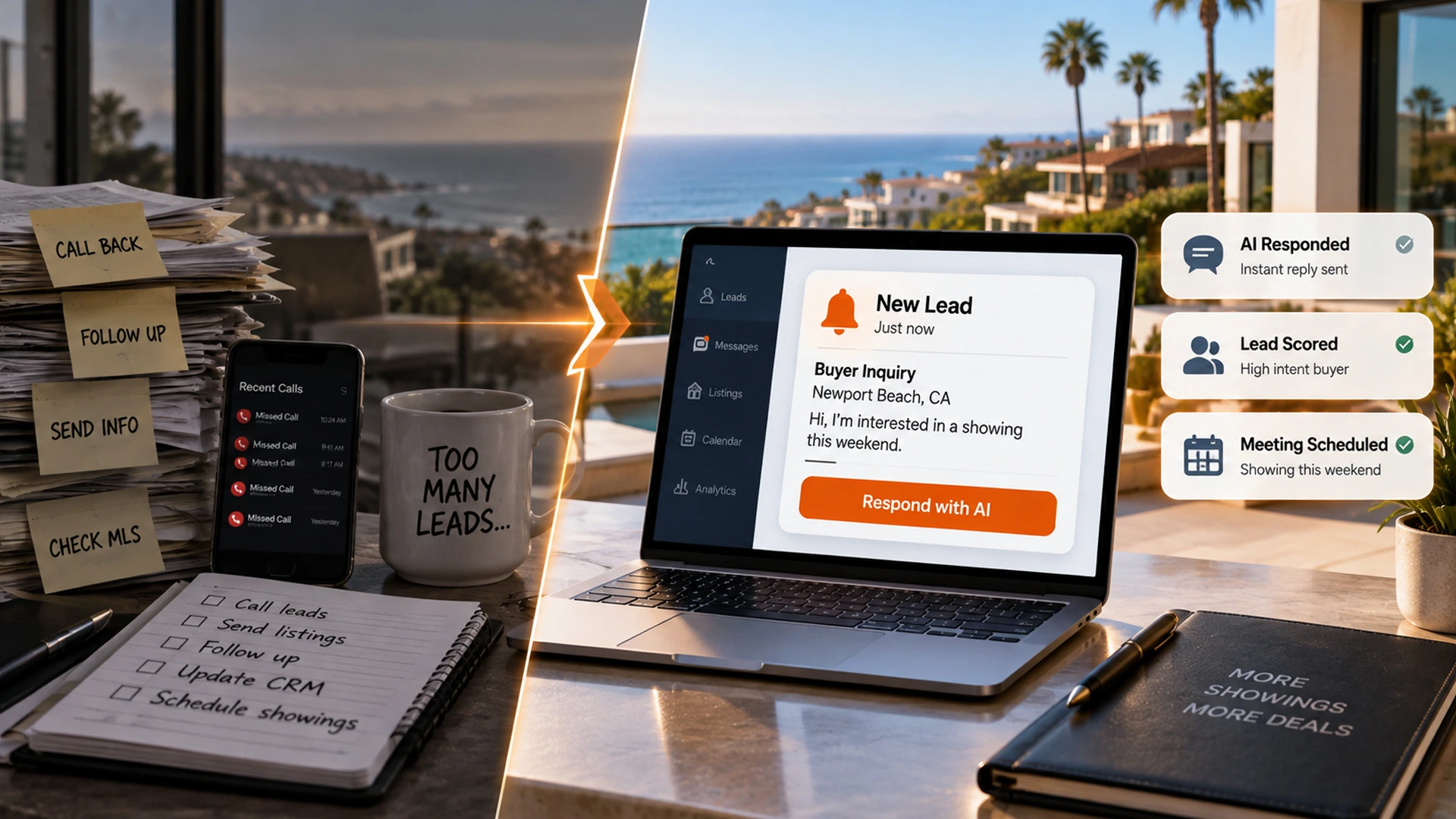
Every unanswered lead is a lost commission. So, brokerages that delay response times pay for lead generation that never converts. AI lead follow-up real estate tools close this gap. They respond within seconds, not hours.
- Buyers who get a response within 5 minutes are far more likely to convert
- Agents waste about 15 hours a week on manual data entry and follow-up texts
- Slow response times are the top reason brokerages lose leads to competitors
Think about what 15 wasted hours a week means. That is almost two full workdays. Multiply that across a whole team of agents, and the cost becomes even clearer.
AI Lead Follow-Up: Never Lose a Buyer to Slow Response Times
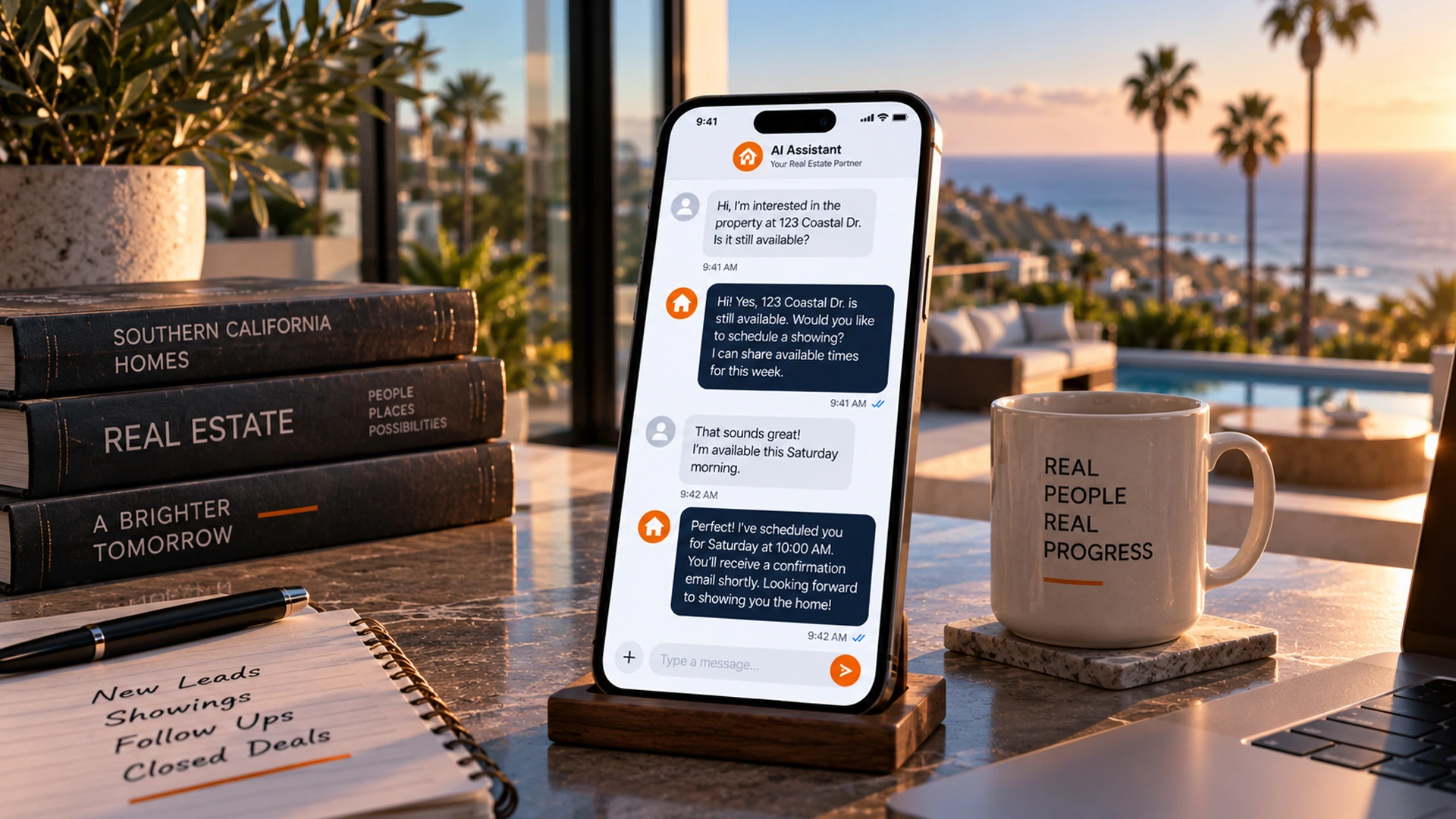
AI lead follow-up real estate systems answer buyer questions right away, day or night. They send a text or email the moment someone fills out a listing inquiry form. Because of this, agents no longer lose leads just because they were in a showing or asleep.
These systems use lead scoring to rank leads by urgency and intent. A lead who asks about financing and wants a showing this week gets a higher score. A lead who just downloaded a market report scores lower. Predictive analytics then flags your hottest leads, so agents know exactly who to call first.
This lead score also helps agents avoid wasted effort. Instead of calling every lead in order, agents can call the most serious buyers first. As a result, agents spend their limited time where it counts most. Over time, this raises both close rates and agent morale.
What Automated Lead Nurturing Looks Like
Lead nurturing does not stop after the first message. Instead, automated workflows keep leads engaged for weeks or months using email and SMS automation. A buyer who is not ready today might be ready in three months. The right sequence keeps your brokerage top of mind until then.
For example, a new buyer might get a welcome email. A week later, they get a market update. A month after that, they get a check-in text. Each message feels timely, not random. This slow build of trust often matters more than any single fast reply.
| Follow-Up Method | Average Response Time | Lead Conversion Impact |
|---|---|---|
| Manual agent callback | 2-24 hours | Low — many leads go cold |
| Basic CRM email blast | Same day | Fair — generic messaging |
| AI-powered chatbots and SMS | Under 60 seconds | High — personal and instant |
Because AI-powered chatbots work around the clock, brokerages capture leads from late-night browsers and weekend house hunters too. This matters a lot in Southern California. Much of the buyer search happens outside normal business hours.
In fact, many buyers browse listings between 8 p.m. and midnight. Without a chatbot, those leads sit untouched until morning. By then, a competing agent may have already replied.
Orange County real estate agent managing incoming leads quickly
Real Estate AI Tools for Listings and Market Trends
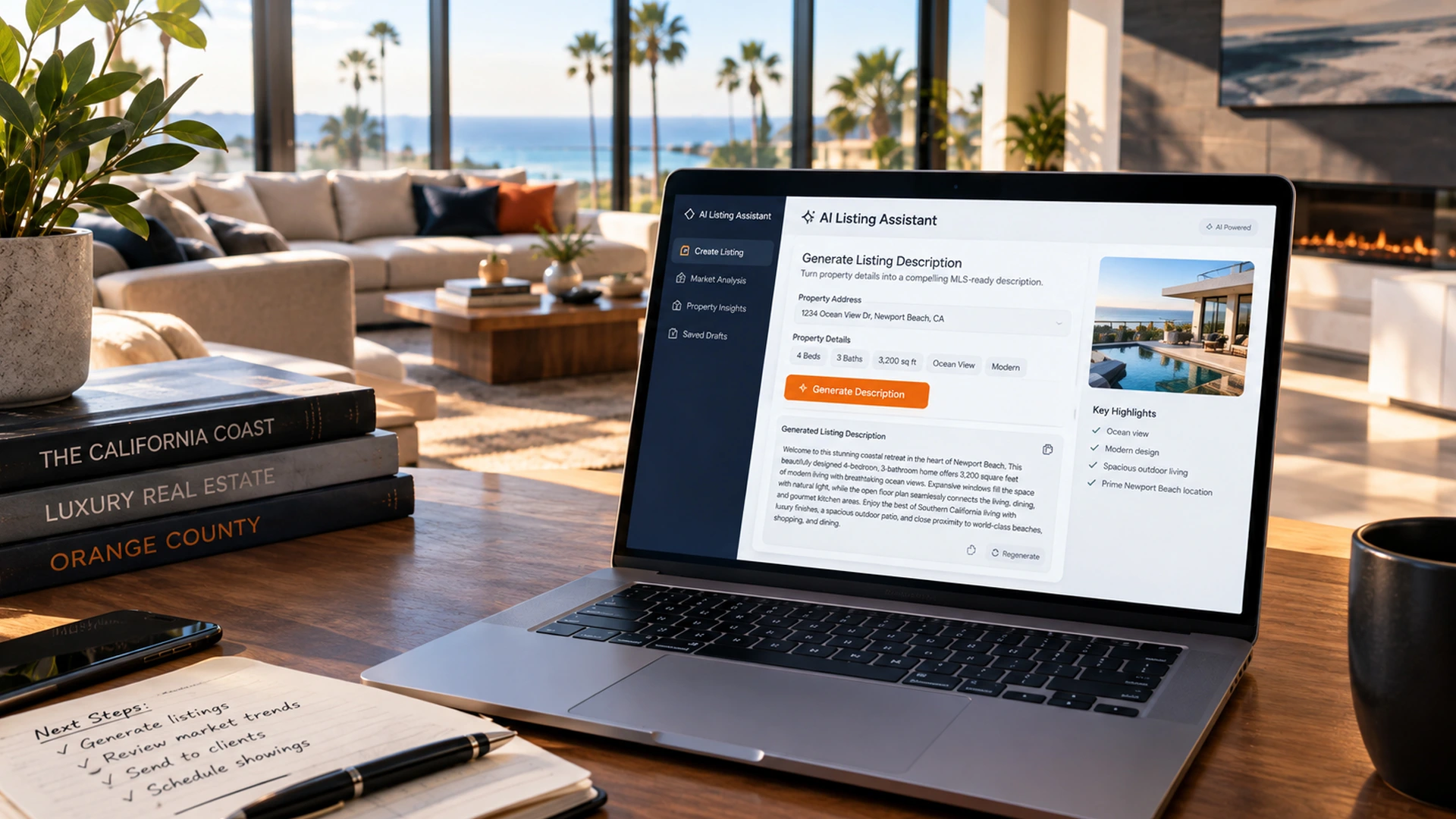
Writing listing descriptions for dozens of properties eats up an agent’s week. Real estate AI tools now write clean, MLS-ready descriptions in minutes. They pull square footage, features, and neighborhood details right from your listing data.
Consider an agent handling ten new listings in a busy month. At thirty minutes each, that is five hours just writing descriptions. With AI tools, the same work takes under twenty minutes total. That saved time can go straight into showings, calls, or new client meetings.
From Listing Descriptions to Market Analysis
Beyond writing, real estate AI tools also support market analysis and property valuation. They compare recent sales, days on market, and price trends across neighborhoods like Irvine, Newport Beach, and Costa Mesa. As a result, agents can give sellers a data-backed pricing plan instead of a guess.
- Automated listing descriptions formatted for MLS integration
- Market comparison reports built in minutes
- Property valuation estimates based on recent comps
- Social media posts and marketing captions made from the same listing data
Also, many of these tools connect directly to MLS integration feeds. New listings sync on their own, without manual re-entry. This lowers errors and keeps every channel showing the same details.
This consistency builds trust with buyers too. When a listing shows the same price and details on Zillow, your website, and social media, buyers feel more confident. Mismatched details can raise doubts before a buyer even calls.
Transaction Coordination: Automating the Paperwork Grind
Closing a deal involves dozens of documents, deadlines, and signatures. Missing one contingency date can delay or kill a sale. Transaction coordination tools track every deadline for you. They alert agents before anything slips through the cracks.
These systems also support client relationships during escrow. They send automatic updates to buyers and sellers, so nobody has to wonder about status. Because of this, agents field fewer “where are we in the process” calls.
Escrow is often the most stressful part of a deal for buyers and sellers. They worry about missed paperwork or delays. Automatic status updates ease that worry and lower the number of anxious phone calls.
Property Management and Post-Close Automation
Automation does not stop once you close. For brokerages that also handle property management, AI-driven workflows can schedule maintenance reminders. They can also send rent collection notices and flag lease renewals for property managers.
- Digital checklist tracks every contingency and disclosure deadline
- Automatic reminders go to agents, clients, and escrow officers
- E-signature workflows cut delays on time-sensitive documents
- Post-close automation supports ongoing property management tasks
For a brokerage managing fifty or more rental units, manual tracking of lease renewals can eat up days each month. Automated flags catch renewals weeks in advance. This gives property managers time to plan.
If your brokerage still tracks escrow deadlines in spreadsheets, it is time to explore real estate automation for Orange County brokerages before your next closing season.
AI lead follow-up real estate text conversation on smartphone
Choosing a Real Estate CRM That Actually Works With AI
Not every real estate CRM supports true automation. Many platforms just store contact info. They don’t connect lead scoring, predictive analytics, or automated workflows into one system. So, brokerages need to check their CRM before adding AI on top.
A strong real estate CRM should link your MLS feed, website forms, and email and SMS tools in one place. Otherwise, agents end up copying data between systems by hand. That defeats the whole point of automation.
Many agents don’t realize how split up their tools are until they try to automate something. A lead might sit in one system, the listing data in another, and email templates in a third. As a result, even simple automation projects can stall out.
Questions to Ask Before Upgrading
Before you sign a contract, ask a few direct questions. First, does the platform offer built-in AI lead follow-up features, or does it need a third-party add-on? Next, can it connect with your current MLS integration and marketing tools? Finally, what does onboarding and support cost?
- Does the CRM offer built-in lead scoring and predictive analytics?
- Can it automate email and SMS follow-up sequences right out of the box?
- Does it sync cleanly with your MLS integration and listing feeds?
- Will your team need custom work to connect older tools?
Many Orange County brokerages use old CRM systems that can’t answer these questions well. In those cases, a custom integration often costs less over time than switching platforms. It keeps years of client history while adding modern automation on top.
Switching platforms also means retraining every agent on a new system. That can take weeks. Custom integration, by contrast, lets agents keep using tools they already know. This often makes adoption much smoother.
How OC Imagine Builds Real Estate AI Automation That Fits Your Brokerage
OC Imagine, based in Irvine, works directly with Southern California brokerages. We build real estate AI automation around the tools agents already use. Instead of forcing a generic template, our team maps your real estate workflow from the first inquiry to the closing signature. Then, we automate the gaps.
This hands-on approach means your brokerage keeps its existing CRM. At the same time, you add AI lead follow-up, automated listing descriptions, and transaction alerts on top. As a result, agents see faster adoption and fewer disruptions than a full platform swap would cause.
We also test each automation with real agents before rolling it out brokerage-wide. This step catches small issues early. It also gives agents a chance to share feedback, so the final system fits how they work day to day.
What a Real Estate AI Project Typically Includes
Every brokerage’s needs are different. Still, most projects include a few common building blocks. Along with lead automation, brokerages often ask for AI-powered chatbots for their website. Many also want custom dashboards for tracking transaction progress.
- AI chatbot and AI assistants for instant lead capture on your website
- Custom real estate CRM integration with existing MLS feeds
- Automated listing description generation tied to property data
- Transaction coordination dashboards with deadline alerts
Because every brokerage’s CRM, listing volume, and team size differ, OC Imagine starts with a short discovery process. This maps your workflow first, so the project focuses on the highest-impact automation. That way, we’re not trying to fix everything at once.
This phased approach also helps control costs. Instead of one large rollout, brokerages can start with the biggest pain point, like slow lead follow-up. Then, once that works well, they can add listing automation or transaction dashboards next.
Real estate AI tools generating listing descriptions in Orange County
Why AI-Driven Automation Is a Competitive Advantage Right Now
The real estate market in Southern California is only getting more competitive. Buyers now expect real time answers from agents and brokerages alike. Because of this, brokerages that adopt AI in real estate today will spend less time chasing leads and more time closing deals.
AI agents don’t replace your team. Instead, they support your team by handling lead qualification, follow-up, and admin work. This frees up real estate professionals to focus on what actually grows the business: showings, negotiations, and client relationships.
Brokerages that wait too long to adopt these tools risk falling behind competitors. Those competitors already respond faster and follow up smarter. Every lead source, from social media posts to open house sign-ins, deserves the same fast follow-up that generation AI now makes possible.
Think of automation as a foundation, not a replacement for good agents. The best results happen when skilled agents use AI to handle the repetitive parts of the job. That way, their time goes toward moments that need a human touch. Negotiating a final offer or comforting a nervous first-time buyer still needs a real person.
Start Automating Your Brokerage’s Lead Follow-Up
Real estate AI automation is no longer optional. Buyers expect an answer in minutes, not hours. Southern California brokerages that use AI lead follow-up real estate tools now will out-respond and out-convert competitors still stuck on manual callbacks.
If your team is ready to modernize lead nurturing, listing production, or transaction coordination, scope your real estate AI automation project with a team that understands both AI integration and the Orange County housing market.
Frequently Asked Questions
How quickly should a real estate agent respond to a new lead?
Ideally within minutes, not hours. Most agents currently take over 30 minutes to respond, and by then the buyer has often contacted another agent. AI lead follow-up systems can respond within seconds through automated text or email, dramatically improving conversion odds.
What is AI lead follow-up in real estate?
It's an automated system that instantly responds to buyer inquiries via text or email, day or night, and then uses lead scoring to rank prospects by urgency and intent. This ensures agents know which leads to prioritize and never lose a buyer simply because they were busy or asleep.
Can AI write real estate listing descriptions?
Yes, real estate AI tools can generate polished, MLS-ready listing descriptions in minutes by pulling square footage, features, and neighborhood details directly from listing data. This can cut the drafting process from about thirty minutes down to under two minutes per listing.
How does AI help with transaction coordination?
Transaction coordination automation tracks contingency dates, disclosure deadlines, and escrow milestones automatically, alerting agents before anything slips. It also sends automated status updates to buyers and sellers, reducing the number of manual check-in calls agents need to handle.
Do I need a new CRM to use real estate AI automation?
Not necessarily. Many Orange County brokerages keep their existing CRM while adding AI capabilities like lead follow-up, listing automation, and transaction alerts on top of it. Custom integration with a legacy CRM can often be more cost-effective than switching platforms, since it preserves years of client history.
What should I look for in a real estate CRM that supports AI?
A strong CRM should integrate with your MLS feed, website forms, and email/SMS automation tools in one place, and offer built-in lead scoring and predictive analytics. It should also sync cleanly with listing feeds without requiring agents to manually copy data between systems.
Does AI automation help beyond closing a real estate deal?
Yes, for brokerages that also handle property management, AI-driven workflows can schedule maintenance reminders, automate rent collection notices, and flag lease renewals. This extends automation value well past the transaction closing date.