Why Small Businesses Are Quitting AI Tools

small business owner reviewing failed ai adoption small business tools on laptop
7 min read
A significant share of small businesses abandon AI tools within a year, not because the technology fails, but because of poor workflow integration, insufficient training, and unclear strategy. The article argues that DIY, off-the-shelf AI tools often break when connected to real business systems, while proper AI consulting and integration with existing CRMs/ERPs deliver stronger, lasting ROI.
A growing number of owners say they drop AI tools within a year of adopting them. Recent survey data shows AI adoption small business trends are reversing, not speeding up. The reason has little to do with the technology itself. Instead, poor setup is quietly sinking a wave of promising pilot projects across Southern California and beyond.
The Surprising Drop in AI Adoption Small Business Owners Report
Several 2025 industry surveys looked at small businesses that adopted generative AI tools. Nearly one in three stopped using them within a year. This goes against the popular idea that AI adoption only climbs. Because expectations ran high, the letdown hit small business owners even harder.
Owners first believed AI would cut costs right away. However, many found that dropping a chatbot or automation script into a workflow without a plan creates more friction than value. As a result, productivity gains never showed up. Excitement faded fast.
What’s Behind These AI Implementation Problems
Most AI implementation problems trace back to three causes. These are weak workflow integration, not enough training, and unclear AI strategy. A tool that works in a demo often breaks when it meets a company’s real data and real customers. Poor data quality is often the hidden culprit behind these failures.
- Employees using AI tools without proper onboarding often go back to old habits
- Disconnected systems mean data doesn’t sync between the AI tool and the CRM
- No one owns the AI strategy after the first rollout
- The AI talent gap leaves small teams without anyone to fix issues
The AI Talent Gap Makes It Worse
Small businesses rarely employ a dedicated AI specialist. So, when a chatbot misfires or an automation breaks, no one on staff knows how to fix it. This talent gap turns a fixable bug into a reason to quit the tool for good.
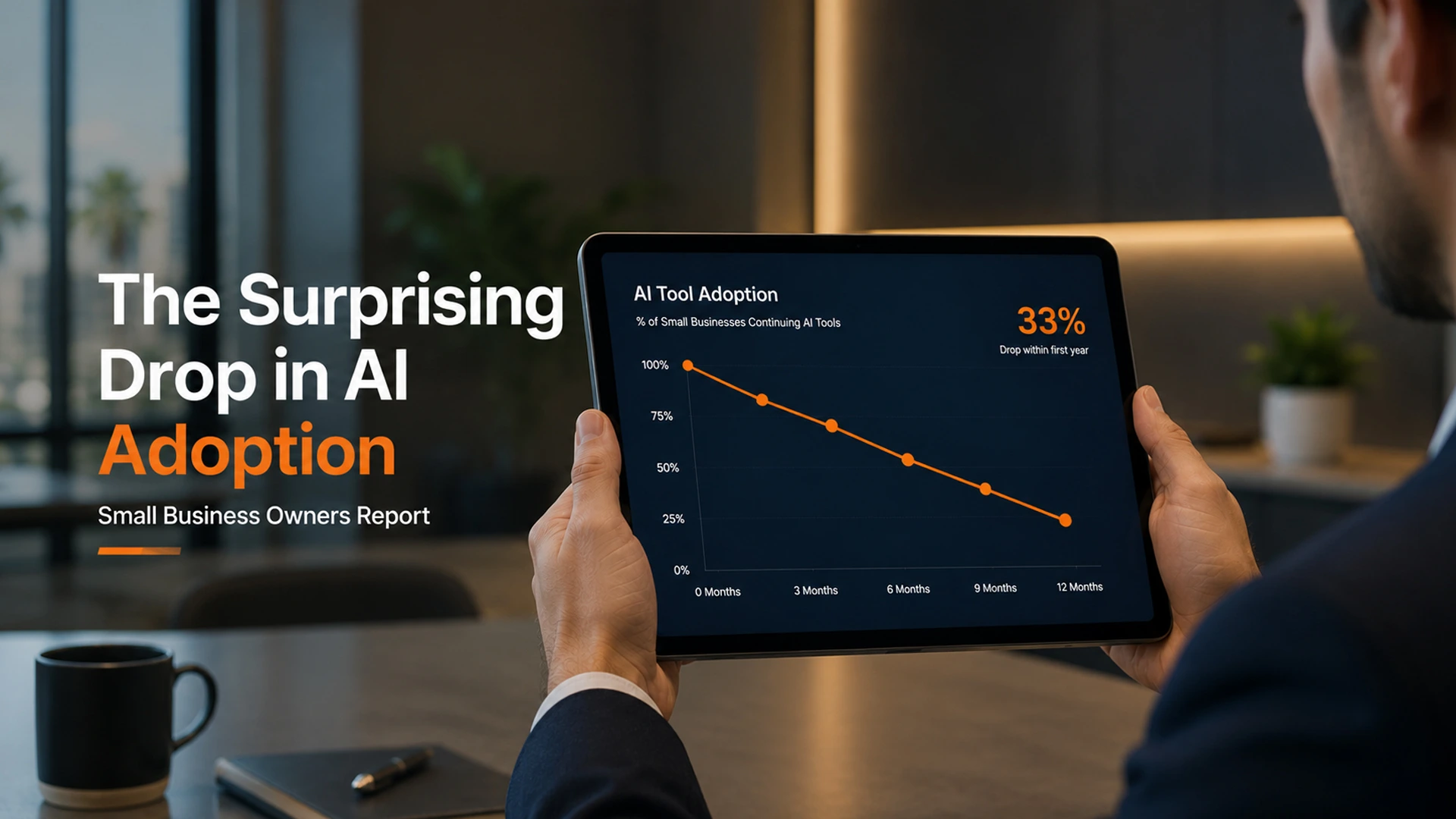
chart showing decline in ai adoption small business statistics
The DIY AI Trap: Why Off-the-Shelf Tools Fail Alone
DIY AI tools sound easy to set up. In reality, most need deep workflow integration to deliver real returns. A generic chatbot added to a website rarely understands a business’s specific customer service needs.
For example, an off-the-shelf scheduling bot might book appointments just fine. But if it cannot talk to the company’s CRM, staff must re-enter every booking by hand. This defeats the whole point of automation. It also fuels pushback from employees who already doubted the tool would help.
DIY AI Approach
Custom AI Integration
Generic chatbot, no CRM sync
AI-enabled tools connected directly to your CRM
No employee training plan
Structured AI training and support
One-size-fits-all use cases
AI use cases mapped to your workflow
Owner troubleshoots alone
Ongoing AI strategy support
Data Privacy, Security, and the Trust Problem
Data privacy and security concerns rank among the top reasons owners hesitate to expand AI use. Customer records, payment details, and internal messages all pass through these systems. So, a breach carries real consequences for the business and its customers.
Many free or low-cost AI tools store data on third-party servers with little transparency. Because of this, businesses handling sensitive information, like healthcare or real estate, need custom AI solutions built with proper safeguards from day one.

employees using ai facing implementation problems at work
How AI Consulting for Small Businesses Fixes What DIY Breaks
Working with an experienced AI consulting for small businesses partner changes the outcome completely. Instead of guessing which tool fits, a proper AI readiness assessment maps your actual workflow, data systems, and business goals first. This helps small business owners integrate AI in a way that actually sticks.
OC Imagine builds AI systems that connect directly to the CRMs, ERPs, and cloud platforms a business already uses. This means employees see AI working inside familiar tools, not as a separate, clunky add-on. In addition, a clear AI strategy roadmap keeps AI initiatives improving instead of stalling after month three.
- Custom chatbots trained on your actual customer service data
- Workflow integration with legacy CRM and ERP systems
- AI training sessions so staff feel confident, not confused
- Ongoing AI support, not a one-time setup
Ready to fix a stalled AI project? Explore custom AI integration services built for Orange County small businesses instead of generic templates.
AI Use Cases That Actually Deliver ROI
Not every AI use case deserves equal investment. Lead screening, appointment setting, and admin automation consistently show the strongest ROI for businesses that deploy AI the right way.
For example, an AI-powered lead screening system can filter inquiries around the clock. This means staff only spend time on qualified prospects. Likewise, automation for appointment setting cuts no-shows and frees up front-desk hours for higher-value work. These AI capabilities boost customer satisfaction, too, since customers get faster replies.
Where OC Imagine Clients See Results
Clients across home services, real estate, and nonprofit sectors report real time savings after a properly integrated rollout. The guide to AI appointment setting tools breaks down exactly how this works in the real world.
If your team dropped an AI tool last year, the problem likely was not the technology. Success depends on integration, training, and an honest strategy. It does not depend on another app download. A thoughtful AI readiness assessment can show exactly where your last attempt went wrong, and where AI models can still support your core operations.

data privacy and security concerns in ai automation for small business
Get Your AI Implementation Back on Track
Don’t let one failed chatbot convince you AI has no value for your business operations. Schedule an AI readiness assessment with OC Imagine. Build a system your team will actually use, and one that leverages AI the way it was meant to work.
Frequently Asked Questions
Why are small businesses abandoning AI tools?
Nearly one in three small businesses that adopted generative AI tools stopped using them within twelve months, largely due to weak workflow integration, insufficient employee training, and lack of a clear AI strategy after rollout. High initial expectations of immediate cost savings also made the eventual friction feel like a bigger letdown.
What is the AI talent gap and how does it affect small businesses?
The AI talent gap refers to small businesses rarely having a dedicated AI specialist on staff. When a chatbot misfires or an automation breaks, no one knows how to troubleshoot it, turning a small, fixable bug into a reason to abandon the tool entirely.
Why do DIY or off-the-shelf AI tools often fail for small businesses?
Off-the-shelf AI tools promise plug-and-play simplicity but usually lack deep integration with a business's existing CRM or ERP systems. This forces employees to manually re-enter data, defeating the purpose of automation and increasing resistance to using the tool.
What are the biggest data privacy concerns with AI tools?
Many free or low-cost AI tools store sensitive customer, payment, and communication data on third-party servers with limited transparency. Businesses in fields like healthcare or real estate need custom AI solutions with built-in safeguards rather than adding security measures after a breach occurs.
How does AI consulting help fix a failed AI implementation?
AI consulting starts with an AI readiness assessment that maps a business's actual workflows, data systems, and customer service goals before recommending tools. This allows automation to connect directly with existing CRMs and ERPs, supported by employee training and ongoing strategy adjustments so the system keeps improving instead of stalling.
Which AI use cases deliver the best ROI for small businesses?
Lead qualification, appointment setting, and administrative automation consistently show the strongest return on investment. For example, AI-powered lead qualification can screen inquiries around the clock, while automated appointment setting reduces no-shows and frees up staff time for higher-value tasks.
How can a business tell if its AI failure was a technology problem or an implementation problem?
In most cases, the technology itself isn't the issue; the failure stems from poor integration, lack of training, or absence of a clear ongoing strategy. An AI readiness assessment can pinpoint exactly where a previous rollout went wrong before trying again.