

Law firm website design Orange County shown on laptop in modern office
Law Firm Website Design: What Wins Clients in Orange County
14 min read
This guide explains how law firm website design in Orange County directly impacts whether potential clients call or click away, covering practice area page structure, intake form design, trust signals, and California Bar advertising compliance. It ties together conversion strategy, local SEO, and site speed into one system built around a client's first moments on the site.
A potential client in Irvine searches for help at 11 p.m. She finds your site on a cracked mobile layout. She closes the tab in under ten seconds.
That moment decides everything. Law firm website design in Orange County shapes whether that visitor calls or leaves. This guide covers what converts, what the State Bar allows, and how to build a site that ranks locally.
Think about how many law firms a potential client checks before picking up the phone. Most people compare three or four sites in one sitting. Because of this, your website is often the real first impression, not the phone call. A slow page or confusing menu can end that chance in seconds.
Why Law Firm Website Design Decides Who Calls You First
Most people hire the first attorney who looks credible and answers their question fast. Because of this, your law firm's website often carries more weight than a referral. A cluttered homepage or vague service list pushes visitors toward a competitor's site instead.
Orange County has a packed, competitive legal market. It stretches from Irvine business litigators to Santa Ana family law firms. As a result, generic templates no longer stand out. Strong attorney website design combines clear navigation, local relevance, and a visible path to contact the firm.
Consider two firms with similar experience and fees. One has a clean site that answers questions fast. The other has a dated template with no clear next step.
The first firm will win more calls, even if both attorneys are equally skilled. Design is part of how clients judge your skill before they even speak with you. This is true for every legal website, no matter the practice area.
This matters even more in a market as crowded as Orange County. A search for "divorce attorney Irvine" or "DUI lawyer Santa Ana" returns dozens of results. Your site has to earn trust in seconds, not minutes. A visitor should never have to guess what you do, where you work, or how to reach you.
What Separates a Converting Site From a Static Brochure
A brochure site lists services and hopes visitors figure out the rest. A conversion-focused design works differently. It answers questions before the visitor has to search for them.
That means clear practice area pages, visible contact options, and proof the firm has handled similar cases before. Good user experience guides a worried visitor toward a phone number or contact form, not away from it.
For example, a brochure site might say "We handle personal injury cases." A conversion-focused page goes further. It explains the types of injury cases handled. It also covers what to do right after an accident, plus how long cases take in Orange County courts.
That extra detail builds trust. It also keeps the visitor reading instead of bouncing to another firm. This kind of site content depth is one of the clearest law firm website best practices today.
The Practice Area Pages That Convert Browsers Into Clients
A dedicated page for each practice area answers the exact question a worried client typed into Google. Write it in simple, everyday language. A single "Practice Areas" dropdown with no detail behind it rarely ranks or converts. It gives search engines and visitors nothing specific to match against their search.
Each practice area page should explain the process, set expectations, and show local relevance. For example, a personal injury page should mention Orange County courts and typical timelines. Skip the generic legal jargon copied from a national template.
- One page per practice area, never a shared catch-all page
- A plain-language explanation of the process and what to expect
- Local references, such as specific Orange County courthouses
- A clear call-to-action near the top and bottom of the page
- Internal links to related practice areas and the attorney's biography
Strong practice area pages also support your blog posts. When a blog post answers a specific legal question, it should link back to the matching practice area page. This builds a clear path for prospective clients to follow, from a general question to a specific service.
Think about a visitor who searches "what happens after a car accident in Orange County." They land on a blog post that walks through the claims process step by step. That post should link right to your personal injury page. From there, a clear call to action invites them to request a free consultation.
It also helps to add a short FAQ section at the bottom of each practice area page. Answer three or four common questions specific to that practice area. For example, a family law page might answer "How long does divorce take in California?" This format matches how people search today. It often appears directly in search results as a featured snippet.
Site Architecture That Search Engines and Clients Both Understand
Site architecture determines how easily Google crawls your pages. It also determines how easily a visitor finds what they need. A flat structure works best. Every practice area should sit one click from the homepage.
Deeply nested menus hurt both rankings and user experience. A flat structure helps both goals improve together instead. Good site architecture also makes it easier to add new landing pages later, without confusing your main menu.
As your firm grows, you may want location-specific pages. For example, one page for Irvine clients and another for Santa Ana clients. A flat structure makes this simple. You can add these pages without rebuilding your entire navigation menu from scratch.
Attorney website design displayed on mobile phone screen
Client Intake Forms That Capture Leads Without Losing Them
A short client intake form converts far better than a long questionnaire. Keep it to five fields or fewer. Ask for name, phone number, email, case type, and a brief message. Save detailed questions for the actual consultation call.
Long forms feel like work to a stressed visitor. Most law firm leads come from mobile phones. So every extra field raises the chance someone quits halfway through. Test your contact form on a phone before you publish it.
| Intake Form Element | Recommended Approach | Why It Matters |
|---|---|---|
| Number of fields | 5 or fewer | Lowers drop-off, especially on mobile |
| Case type selector | Dropdown with practice areas | Routes leads to the right attorney faster |
| Response time note | State a specific timeframe | Builds trust and sets expectations |
| Privacy note | Brief, visible near the submit button | Needed context that reduces hesitation |
Call-to-action placement matters just as much as the form itself. Place one form above the fold. Repeat one after the practice area explanation. Add another in the footer.
This gives visitors several easy chances to reach out. None of them will feel pushed into it. Smart calls to action, placed at natural points, raise form completions without changing your design at all.
Button text matters too. "Submit" feels cold and plain. Instead, try "Get Your Free Consultation" or "Talk to an Attorney Today." Small wording changes like this can raise completion rates without any design work.
It also helps to add a short line of reassurance near the form. Something like "We reply within one business hour" sets a clear expectation. It also eases the worry many visitors feel before reaching out to a lawyer for the first time.
Trust Signals Orange County Clients Look for Before They Call
Attorney biography pages do more work than almost any other page on a law firm website. A visitor wants to know who will handle their case. They need more than proof that a firm exists. Include bar admission dates, law school, case types, and a real photo.
In addition, client reviews, bar group memberships, and years spent practicing in Orange County all help build trust. A firm founded in Irvine with a decade of local experience should say so clearly. Local roots matter to clients comparing several firms at once.
- Attorney biography pages with credentials and bar number
- Case results, where permitted, with required disclaimers
- Client reviews with proper context
- Memberships in the Orange County Bar Association or similar groups
- Press mentions or published articles by the attorney
These trust signals work best when they appear across the whole site, not just on one page. A strong legal website repeats proof points on the homepage, practice area pages, and attorney bios alike.
Video also builds trust faster than text alone. A short thirty-second clip of the attorney explaining their approach can make a site feel far more personal. Visitors often remember a face and voice longer than they remember written text.
Awards and badges matter too, but only with context. A badge from a legal rating group means little without a short note on what it represents. Add a sentence near any award logo that explains what it means and how the attorney earned it.
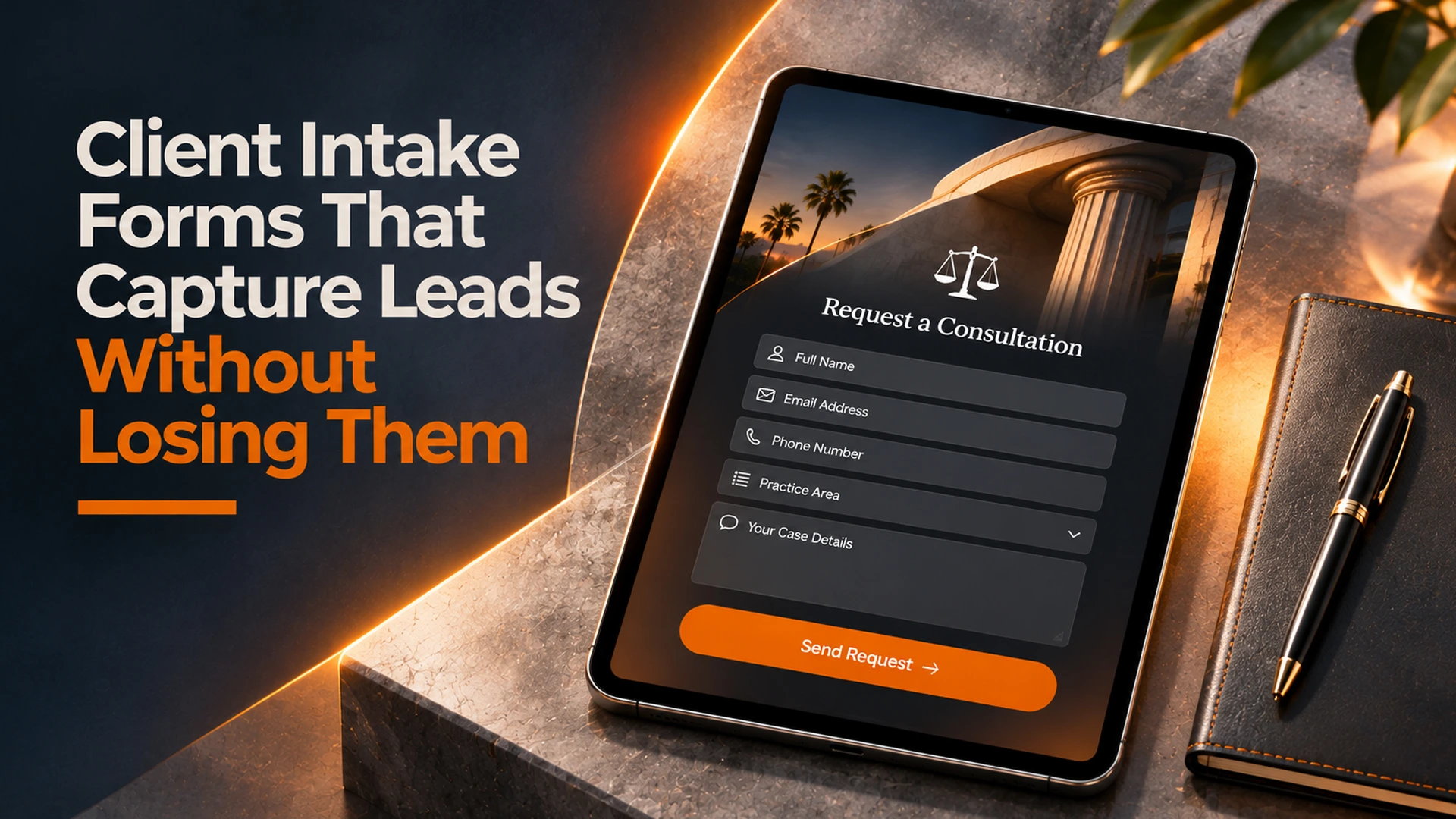
Legal website design client intake form on tablet device
What California Bar Advertising Rules Allow on Your Site
California's Rules of Professional Conduct govern how attorneys describe services online. Rule 7.1 bans false or misleading claims. Related rules cover claims about results and comparisons to other lawyers. Bar advertising compliance is not optional, so website copy needs careful review before launch.
If you publish past case results or client reviews, California requires a disclaimer. It must state that results depend on the facts of each case. It should also state that past results do not guarantee a similar outcome. Avoid phrases that imply a guaranteed result. Also avoid comparing your firm against named competitors in a negative way.
Many firms also wonder about reviews collected through Google or Yelp. These generally fall under the same ad rules as reviews on your own site. If you feature a glowing review on your homepage, add the same type of disclaimer nearby.
Practical Compliance Steps for Your Website Copy
Work with your webmaster or a legal marketing agency familiar with bar rules before you publish claims-based content. A simple review checklist helps you avoid costly rewrites later.
- Add disclaimers near any case results or client reviews
- Avoid words like "best" or "top" without proof
- Clearly label attorney advertising where required
- Keep comparisons general, never naming other firms
- Have a licensed attorney review final copy before publishing
It also helps to keep a simple internal log of where disclaimers appear on your site. As you add new blog posts or case results pages, check this log. That way, nothing gets published without the required language.
Need help scoping a compliant, conversion-ready site for your practice? Explore custom web design services built with these rules in mind from the first wireframe.
Speed, Mobile Design, and Local SEO for Orange County Firms
A site that loads in under three seconds keeps more visitors than one that takes five seconds or longer. Google also uses page speed as a ranking factor. Because of this, slow sites lose visibility before a client even sees them. Responsive design, where the layout adapts cleanly to any screen size, is no longer optional for legal websites.
Mobile-friendly design means large, tappable buttons and text you can read without zooming. It also means forms that work smoothly on a phone keyboard. Most searches for an attorney happen on mobile during a stressful moment. So a clunky mobile experience can cost a firm real cases.
Image size is one of the most common causes of slow law firm websites. A single uncompressed photo can weigh several megabytes. That alone can slow a page down by seconds. Compressing images and using modern file formats keeps pages fast without hurting visual quality.
Website hosting also plays a role here. A cheap, shared hosting plan often struggles once a site gets real traffic. Investing in reliable hosting built for business sites keeps load times steady, even during busy periods.
Local SEO and Google Business Profile Optimization
Local SEO determines whether your firm shows up when someone searches "attorney near me" in Irvine or Santa Ana. An optimized Google Business Profile helps a great deal. So does matching name and address information across directories. Location-specific content on your site also boosts local rankings.
Furthermore, embedding a map, listing office hours, and collecting genuine reviews on your profile all strengthen local visibility. These efforts pair directly with practice area pages that mention specific Orange County cities and courts.
Consistency matters more than people expect here. If your firm's address appears one way on your website and a different way on Yelp or an old directory, it can confuse search engines. This is called a NAP mismatch, short for name, address, and phone number. Fixing these mismatches often improves local rankings within a few weeks.
Replying to reviews, both good and bad, also signals activity to Google. A firm that replies to reviews looks more engaged than one with reviews sitting untouched for years. Keep replies short, professional, and free of any private case details.
Curious how your firm's current site performs on speed and mobile use? See how OC Imagine approaches legal website projects for firms across Orange County.
Attorney reviewing legal website design for bar advertising compliance
Structured Data and AI Search Visibility for Law Firms
Structured data is code added behind the scenes. It tells search engines exactly what your content means, such as marking an attorney's name, practice area, or office address. This markup helps your firm appear in rich search results and voice search answers.
Moreover, AI search tools like Google's AI Overviews now sum up answers right on the results page. A site with clear, organized content and proper headings has a better shot at getting cited in these summaries. Thorough, well-researched pages beat thin placeholder text every time.
Search engine optimization for law firms today means writing for people first and machines second. Clear answers, logical headings, and specific local details consistently beat keyword-stuffed pages that read awkwardly to a real visitor. This is a core part of AI search visibility going forward.
Schema types common for law firms include LocalBusiness, Attorney, and FAQPage markup. Adding FAQ schema to your practice area pages can help your questions appear directly in search results.
As AI search tools grow more common, firms that publish clear, well-built, and genuinely helpful content will likely win out. Thin content written only to target a keyword tends to get skipped in favor of pages that fully answer a question.
Ready to rebuild your firm's site around these ideas? Scope a custom law firm website project and build a site that converts, complies, and ranks.
Common Mistakes That Hurt Law Firm Website Designs
Even firms with a decent budget make avoidable mistakes. These errors quietly push prospective clients away. Often, nobody on staff notices until leads drop off.
- Burying the phone number instead of placing it in the header on every page
- Using stock photos instead of real photos of the attorneys and office
- Writing practice area pages that sound identical from firm to firm
- Skipping mobile testing before launch, which breaks forms and buttons
- Ignoring page speed, which quietly drains both rankings and conversions
Fixing these issues does not require a full rebuild in most cases. Often, a few targeted updates to your existing law firm website can raise conversions within weeks. Small, steady fixes also tend to work better long term than one massive redesign every five years.
Another common mistake is letting a website sit untouched for years after launch. Laws change, practice areas shift, and old case results can become outdated or even misleading. A yearly review of your site content, paired with the compliance checklist above, keeps your firm both accurate and current.
Firms also sometimes forget to check how their site looks across different browsers and devices. A site that looks perfect on a new iPhone might break on an older Android phone or a tablet. Testing across a range of devices catches these issues early, before they cost you real leads.
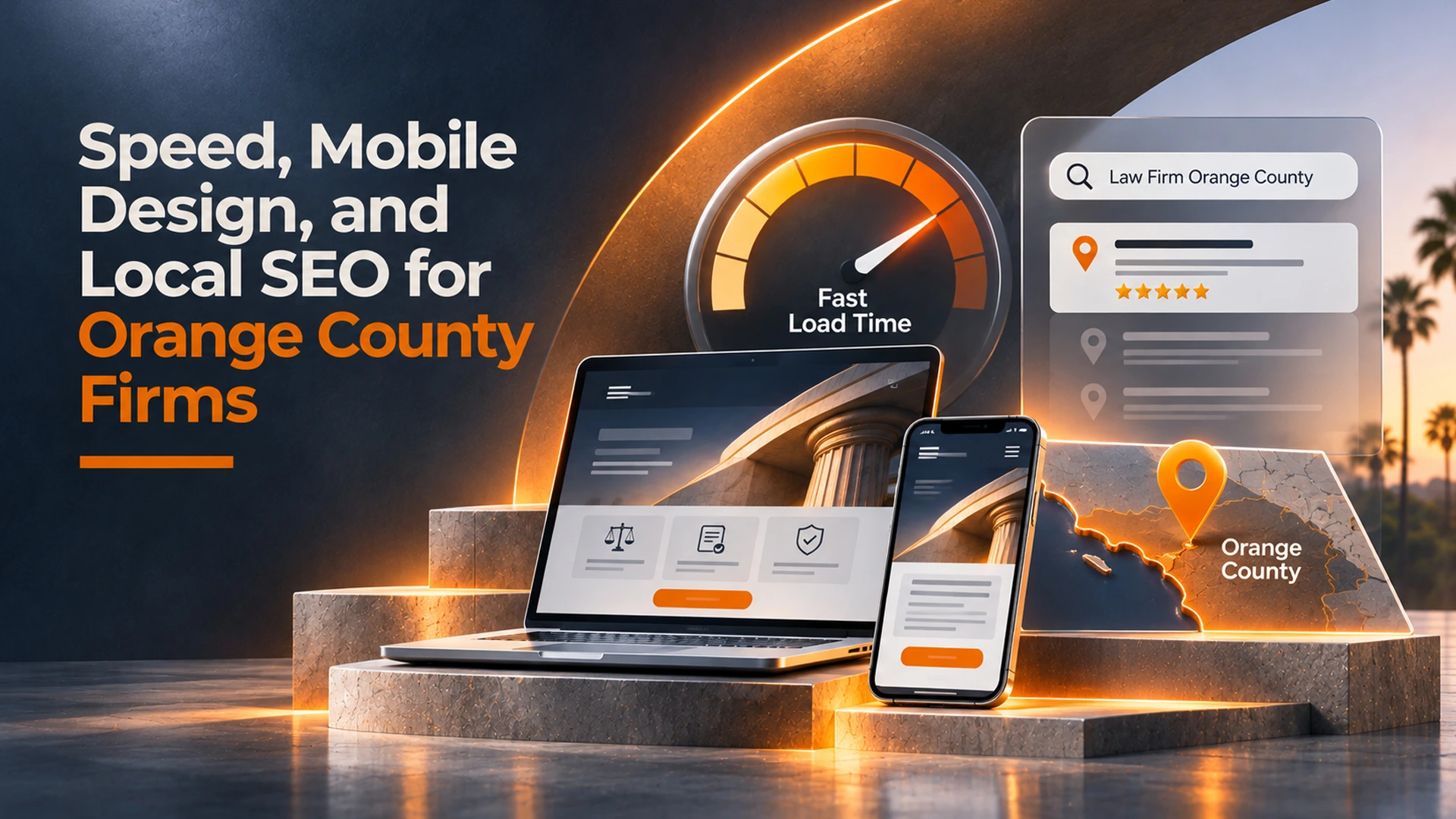
Law firm website design Orange County page speed and local SEO graphic
How Digital Marketing Supports Your Website Long Term
A great website is not a one-time project. It needs steady attention to stay competitive in the legal industry. Digital marketing work, such as content updates, link building, and review generation, keeps a site fresh for both visitors and search engines.
For example, publishing new blog posts on common legal questions keeps your site active. It also gives Google fresh content to index. Over time, this builds authority around your practice areas and brings in a steady stream of organic traffic.
Frequently Asked Questions
How much does a law firm website cost?
Costs vary widely based on the number of practice area pages, custom design work, and features like intake forms or attorney bio sections, rather than a single fixed price. Firms investing in a conversion-focused site with proper compliance review, local SEO, and structured data typically pay more upfront than for a generic template, but the guide emphasizes that a cheap brochure site often costs more in lost leads over time.
What should a law firm website include to convert visitors into clients?
A converting site needs individual practice area pages written in plain language, a short intake form with five fields or fewer, visible calls-to-action above and below the fold, and attorney biography pages with credentials and bar numbers. It should also load in under three seconds, work cleanly on mobile, and include trust signals like client reviews and bar association memberships.
What are the California Bar rules for law firm website advertising?
California's Rules of Professional Conduct, particularly Rule 7.1, prohibit false or misleading communications about legal services, including unsubstantiated claims and comparisons to other named firms. Any published case results or testimonials must include a disclaimer stating that outcomes depend on each case's facts and don't guarantee similar results, so copy should be reviewed by a licensed attorney before launch.
Why isn't a single 'Practice Areas' dropdown page enough for a law firm site?
A shared catch-all practice areas page gives search engines and visitors nothing specific to match against their exact question, so it rarely ranks or converts well. Each practice area needs its own dedicated page explaining the process, setting expectations, and referencing local details like specific Orange County courthouses, which helps both search visibility and visitor trust.
How many fields should a law firm's intake form have?
Five fields or fewer performs best: name, phone, email, case type, and a brief message. Longer forms feel like extra work to a stressed visitor, and since most law firm leads come from mobile phones, each additional field increases the chance someone abandons the form before submitting.
How does local SEO help an Orange County law firm get found online?
Local SEO determines whether a firm appears when someone searches for an attorney near them in cities like Irvine or Santa Ana. This includes an optimized Google Business Profile, consistent name and address details across directories, location-specific content on practice area pages, and genuine client reviews, all of which strengthen local search rankings.

