Agentic AI Trends Small Businesses Should Watch


A small business owner in a bright modern Irvine office watching a laptop dashboard where autonomous digital workflow icons move between apps, warm…
13 min read
Agentic AI is moving beyond chatbots into autonomous agents that plan, execute, and complete multi-step business tasks with minimal human oversight, and this shift is accelerating as CRMs, scheduling tools, and other everyday software embed these capabilities by 2026. The article outlines key trends small businesses should watch, practical steps to prepare for adoption, and common pitfalls to avoid when rolling out autonomous AI agents.
Agentic AI for business is no longer just a buzzword for tech giants. By 2026, autonomous AI agents will handle tasks that once needed a person to click, type, or approve each step. Small businesses that understand this shift now will gain a real edge. Meanwhile, competitors stuck on basic chatbots will fall behind.
What Is Agentic AI (And How It Differs From Chatbots)
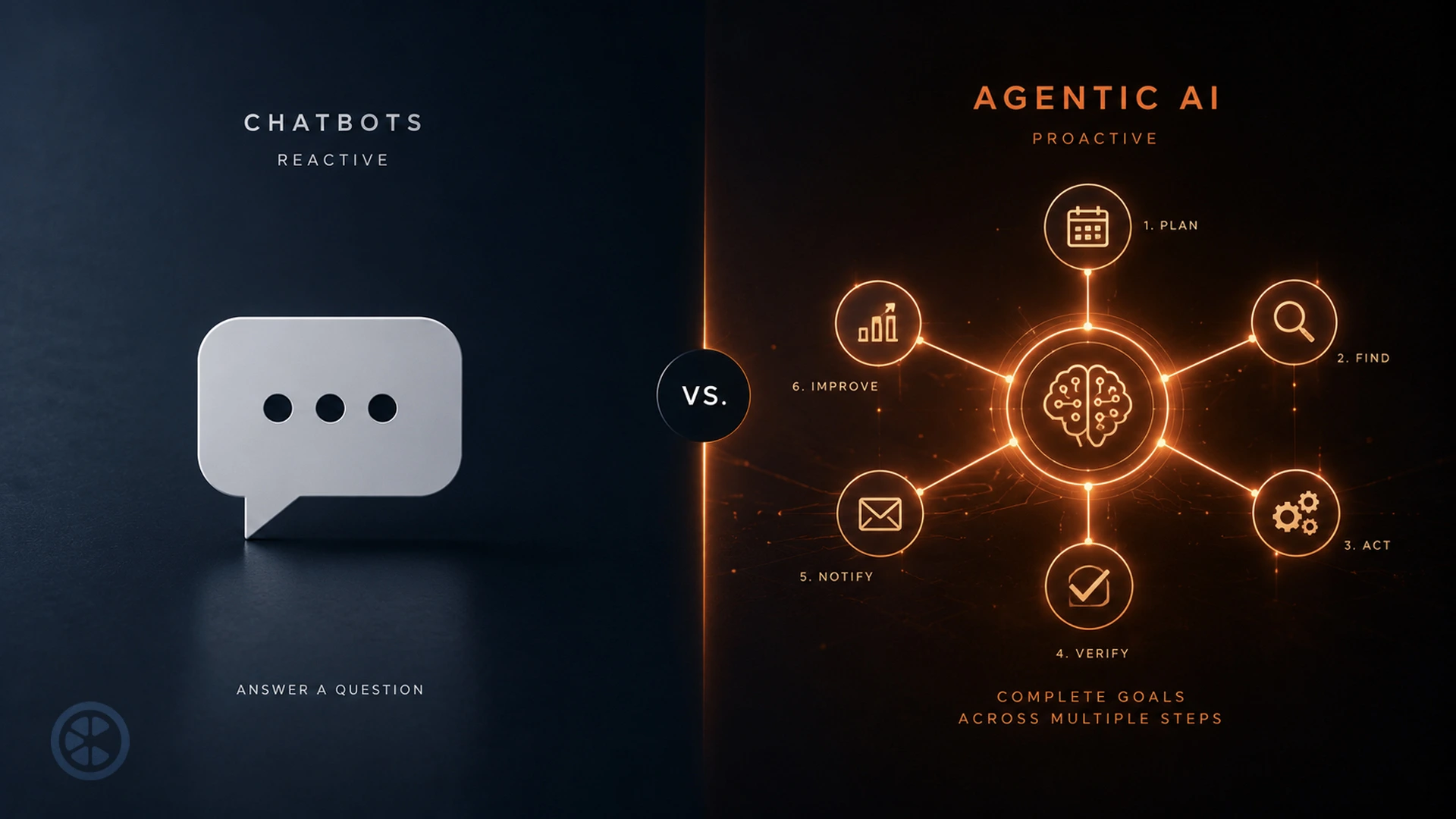
Agentic AI is software that takes independent action to reach a goal. It does not just answer a question. A chatbot responds only when you prompt it. However, an autonomous AI agent can plan steps, use tools, and finish a task with little human input.
For example, a chatbot might tell a customer their order status. An agentic system, on the other hand, could check inventory, reroute a delayed shipment, and notify the customer on its own. This matters because agentic AI for business means less manual oversight. It also means more steady results.
Generative AI plays a role here too. It helps agents write messages, summarize data, and create content as they work. So, the agent does not just follow a script. It adapts based on what it finds.
- Chatbots: reactive, answer one question at a time
- AI agents: proactive, complete multi-step tasks
- Autonomous AI agents: operate with minimal human review, often across multiple apps
Why 2026 Marks a Real Shift for Small Business AI
Gartner says about one-third of enterprise software will include agentic AI by 2028. That is up from less than 1% in 2024. Because of this, small businesses will feel this shift sooner than they expect. The tools they already use, like CRMs and scheduling platforms, will simply come with agent features built in.
This matters a lot for AI trends 2026 small business owners are tracking closely. Instead of buying a separate AI tool, businesses will find agentic features already inside the software they pay for. So, adoption will not feel like a huge leap. It will feel more like turning on a new setting.
This shift also touches customer service and customer support. Agents can answer routine questions, process refunds, and update account details. As a result, human staff can focus on harder problems that need real judgment.
What Changed Since Prompt-Based Tools
Early AI tools needed a person to write a prompt every time. Agentic AI flips that setup. Instead, it sets its own smaller goals. It checks its own work. It asks for help only when it gets stuck.
This change cuts the daily workload for small teams by a lot. Because the AI can work on its own, staff spend less time on repeat tasks. They can then spend more time on work that truly needs a human touch.
Split-screen style composition showing a simple chat bubble icon on one side and a connected network of glowing task icons on the other, representi…
Top Agentic AI Trends Small Businesses Should Watch
Several trends stand out as owners plan their 2026 technology budgets. Understanding these now helps businesses avoid falling behind. Meanwhile, competitors who move fast will pull ahead in automation.
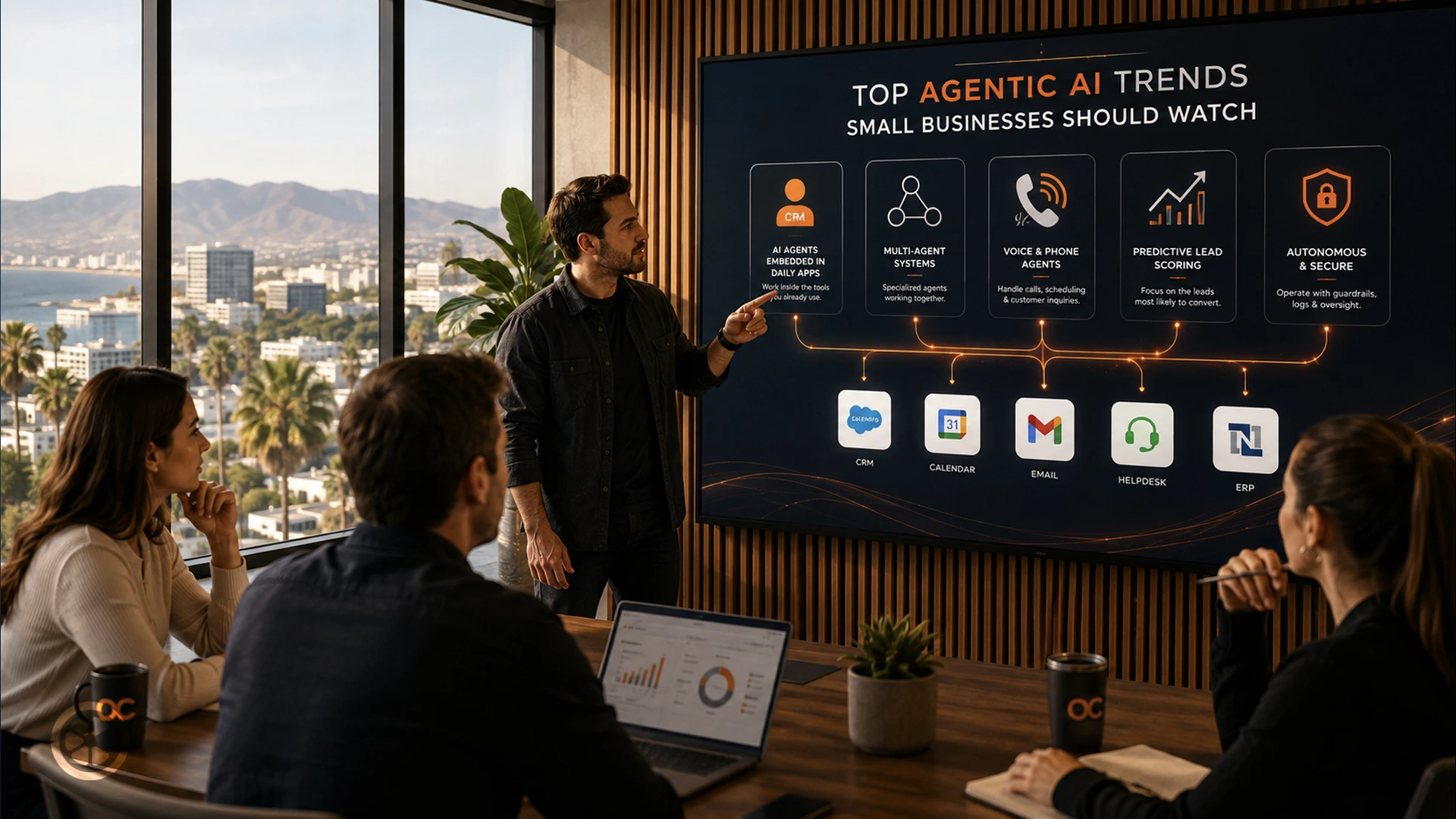
AI Agents Embedded in Daily Apps
Instead of stand-alone AI tools, agentic features will live inside CRMs, email platforms, and accounting software. For instance, an Orange County AI CRM platform might automatically qualify leads, schedule follow-ups, and update deal stages. No rep needs to touch the screen.
This embedded approach lowers the cost of entry too. Small business owners will not need to learn a brand new system. Instead, they will unlock new AI powered features inside tools they already know.
Multi-Agent Systems Working Together
Rather than one agent doing everything, businesses will use several specialized agents. These agents hand off tasks to each other, much like a relay team. One agent might handle customer intake. Another manages billing. A third tracks appointment reminders.
This setup mirrors how a supply chain works. Each link handles one job well, then passes the work forward. As a result, tasks move faster and with fewer errors.
Voice and Phone-Based Agents
AI phone automation and AI answering service tools are moving past scripted responses. Now, they show true agentic behavior. These systems can reschedule appointments, check availability, and send tough calls to a human. All of this happens in real time.
Because these agents work autonomously, they can also analyze data from past calls. That means they get smarter about common requests over time. In addition, they can flag issues that need a manager’s attention right away.
Predictive Lead Scoring and Data-Driven Decisions
Agentic systems increasingly analyze data to rank leads by how likely they are to buy. Instead of a rep guessing which lead to call first, the system does the work. It looks at browsing habits, past purchases, and email replies.
These decisions based on real data help sales teams focus their time better. For example, a rep might only call the top 20% of leads that the system flags as hot. That means fewer wasted calls and more closed deals.
Trend
What It Does
Business Impact
Embedded AI agents
Built into CRM, email, and ERP tools
Lower setup cost, faster adoption
Multi-agent workflows
Agents hand off tasks to each other
Fewer manual handoffs, faster turnaround
Voice-based agents
Handle calls and scheduling autonomously
Reduced missed calls and staff hours
Predictive lead scoring
Ranks leads by likelihood to convert
Sales teams focus on the best prospects
Autonomous AI Agents in Everyday Business Apps
Autonomous AI agents now work quietly inside tools your team already uses. This section breaks down what that looks like for small and mid-sized businesses.
An AI-powered lead qualification system can scan a new form submission. Then, it checks that data against past customer records. Next, it routes hot leads straight to a sales rep. Meanwhile, colder leads enter a nurture sequence on their own, without anyone lifting a finger.
- CRM agents that update records and flag stale deals
- Scheduling agents that book, confirm, and reschedule appointments
- Support agents that resolve common tickets before a human sees them
- Analytics agents that flag unusual sales or inventory trends
Real estate teams in Southern California use real estate AI automation to follow up with buyers within minutes of an inquiry. Because agentic systems act fast, businesses close more deals before a competitor even replies.
This speed also boosts customer experience. Buyers feel heard right away instead of waiting hours or days for a reply. In addition, faster replies build trust, which often leads to repeat business and referrals.
Other industries see similar gains. A local HVAC company, for example, might use an agent to confirm service appointments and send reminder texts. This means fewer no-shows and a smoother schedule for the whole team.
A modern Orange County small business team reviewing a large screen with automated workflow steps and connected app icons like CRM, calendar, and e…
How to Prepare Your Business for Agentic AI
Preparing for agentic AI for business does not need a huge budget. You also do not need an in-house engineering team. A focused, step-by-step plan works better than trying to automate everything at once.
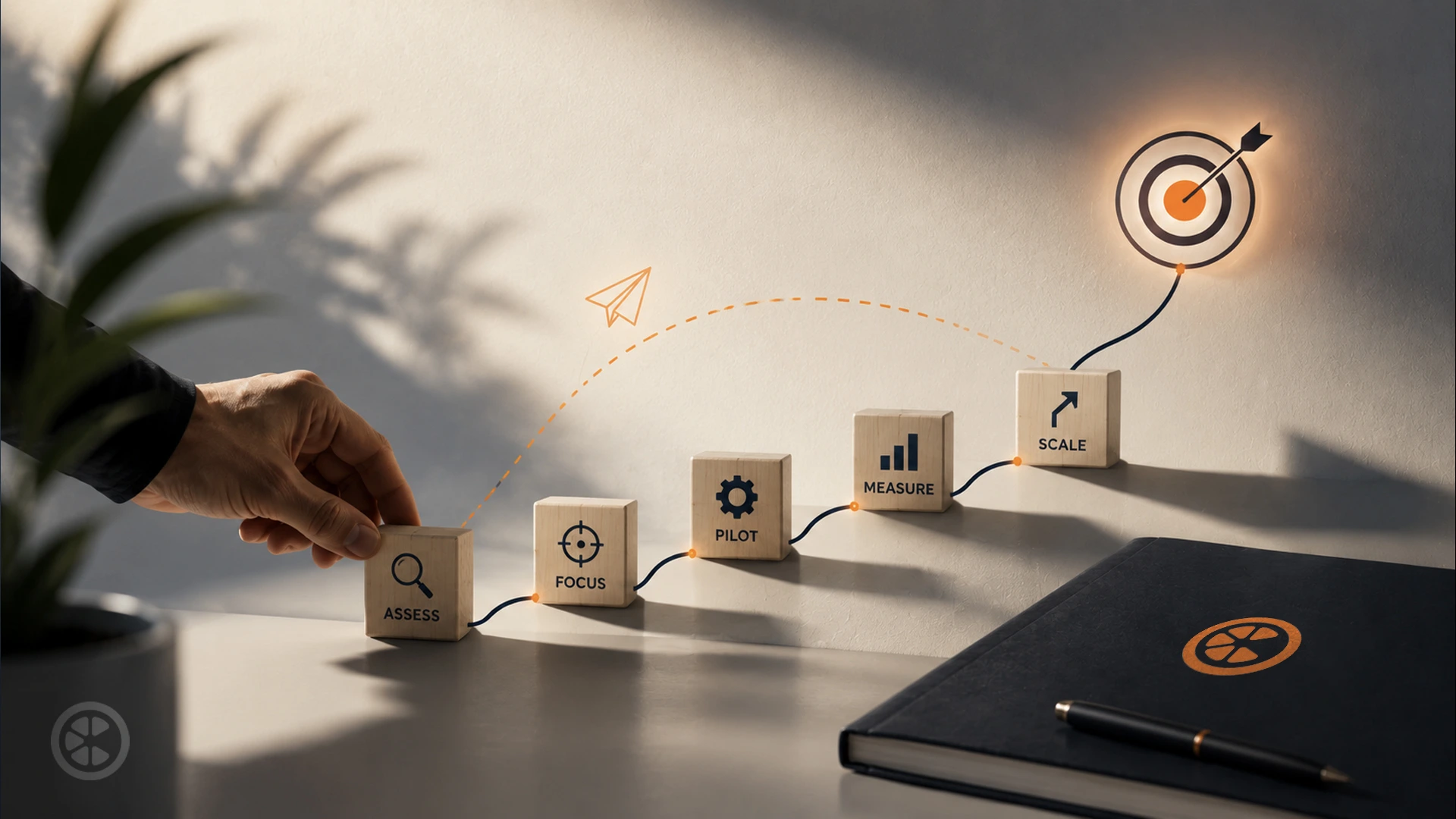
Start With an AI Readiness Assessment
First, review your current workflows and data quality. An AI readiness checklist should cover which systems talk to each other. It should also note where your data lives and which tasks eat up the most staff time each week.
- Audit current workflows and identify repetitive tasks
- Check data quality across your CRM and other tools
- Choose one pilot process, such as lead follow-up or appointment setting
- Select an autonomous AI agent that integrates with existing software
- Measure results for 30 to 60 days before expanding
This process helps you spot the desired outcome for each task before you turn on any automation. For example, if the goal is fewer missed calls, track that number before and after the pilot. That way, you have real proof the agent is working.
Think About Long Term Goals, Not Just Quick Wins
It helps to think about your long term plans, not just fast fixes. Ask yourself where your business wants to be in two or three years. Then, choose AI solutions that can grow with you.
For instance, a scheduling agent that works well today should also handle more volume later. As a result, you avoid switching tools every year. Instead, you build on a system that continuously improves as it learns from more real world data.
Choose the Right Partner
System integration services vary a lot in quality. Because of this, it helps to work with a team that understands both AI and your current tech stack. OCImagine, based in Irvine, builds custom AI solutions that connect directly to CRMs, ERPs, and cloud platforms. Best of all, this happens without disrupting your daily operations.
Ready to see what agentic AI for business could look like for your company? Explore OCImagine’s AI integration services to see how autonomous agents fit into your existing workflow.
Common Pitfalls When Adopting Autonomous AI Agents
Not every rollout goes well. So, it helps to know common mistakes before you start.
Poor data quality causes most agentic AI failures. If your CRM has duplicate records or missing fields, an autonomous agent will act on bad information. Because of this, businesses should clean their data before they roll out any agent-based workflow.
- Skipping the pilot phase and automating too much at once
- Ignoring data quality issues in legacy systems
- Failing to set clear boundaries on what the agent can decide alone
- Not training staff on how to review agent decisions
The National Institute of Standards and Technology (NIST) says businesses should set up clear risk management plans before they scale automation. This advice applies just as much to a five-person shop as it does to a large company.
Another common mistake is removing human oversight too soon. Even the best autonomous agents work better when a person checks in from time to time. For example, a manager might review 10% of agent decisions each week to spot patterns or errors early.
In addition, some businesses try to automate every process at once. This often backfires. Instead, start small, learn what works, and then expand step by step. That way, small business owners keep control of the process while agents work in the background.
Close-up of hands sketching a simple roadmap with numbered steps on a whiteboard in a bright consulting office, laptop and notebook nearby, warm co…
The Road Ahead for Small Business AI
Looking past 2026, agentic AI will likely spread into more corners of daily business. Marketing teams may use agents to test ad copy and adjust budgets on their own. Finance teams may use agents to flag odd transactions before they become real problems.
Because these systems continuously improve, early adopters often see the biggest gains. The more data an agent processes, the better it gets at matching actions to your desired outcome. That means businesses that start now build an edge that grows over time.
Of course, no tool replaces good judgment. Human oversight will always matter, even as agents grow smarter. The goal is not to remove people from the loop. Instead, the goal is to let agents work through the boring, repetitive parts of a job so people can focus on strategy and relationships.
Move Forward With Agentic AI Confidently
The shift toward agentic AI for business is not some far-off trend. It is already happening inside the apps your team uses every day. Small businesses that start small, measure results, and pick the right integration partner will see the biggest gains from autonomous AI agents in 2026.
OCImagine helps Orange County businesses build a clear, practical roadmap for AI adoption. This ranges from one automated workflow to a full multi-agent system. If you are ready to move past basic chatbots and put autonomous AI agents to work, start your custom AI solutions consultation today.
Frequently Asked Questions
What is agentic AI and how is it different from a chatbot?
Agentic AI refers to software that takes independent action to complete a goal, planning steps and using tools without constant human input, whereas a chatbot only reacts to prompts one question at a time. For example, a chatbot might report an order status, while an agentic system could check inventory, reroute a shipment, and notify the customer automatically.
Why is 2026 considered a turning point for small business AI adoption?
Gartner projects that roughly one-third of enterprise software applications will include agentic AI capabilities by 2028, up from less than 1% in 2024, meaning tools small businesses already use like CRMs and scheduling platforms will simply come with agent features built in. This makes adoption feel like flipping a switch rather than a major technology overhaul.
What are the main agentic AI trends small businesses should watch?
Key trends include AI agents embedded directly in everyday apps like CRMs and email platforms, multi-agent systems where specialized agents hand off tasks to each other, voice and phone-based agents that handle scheduling and calls autonomously, and predictive lead scoring that ranks prospects by conversion likelihood.
How can a small business start preparing for agentic AI?
Businesses should begin with an AI readiness assessment that audits current workflows, checks data quality, and identifies repetitive tasks. From there, they should choose one pilot process such as lead follow-up, select an agent that integrates with existing software, and measure results for 30 to 60 days before expanding further.
What are the most common mistakes businesses make when adopting autonomous AI agents?
Common pitfalls include skipping the pilot phase and automating too much at once, ignoring data quality issues in legacy systems, failing to set clear boundaries on what the agent can decide independently, and not training staff to review agent decisions. Poor data quality is cited as the leading cause of agentic AI failures.
Do small businesses need a large budget or in-house engineers to adopt agentic AI?
No, the article emphasizes that preparing for agentic AI does not require a massive budget or an in-house engineering team. A focused, step-by-step approach, such as piloting one process and choosing the right integration partner, works better than trying to automate everything at once.
How are real estate and other local businesses already using agentic AI?
Real estate teams in Southern California use real estate AI automation to follow up with buyers within minutes of an inquiry, allowing them to close more deals before competitors even respond. This illustrates how instant, autonomous action gives businesses a competitive edge over manual follow-up processes.